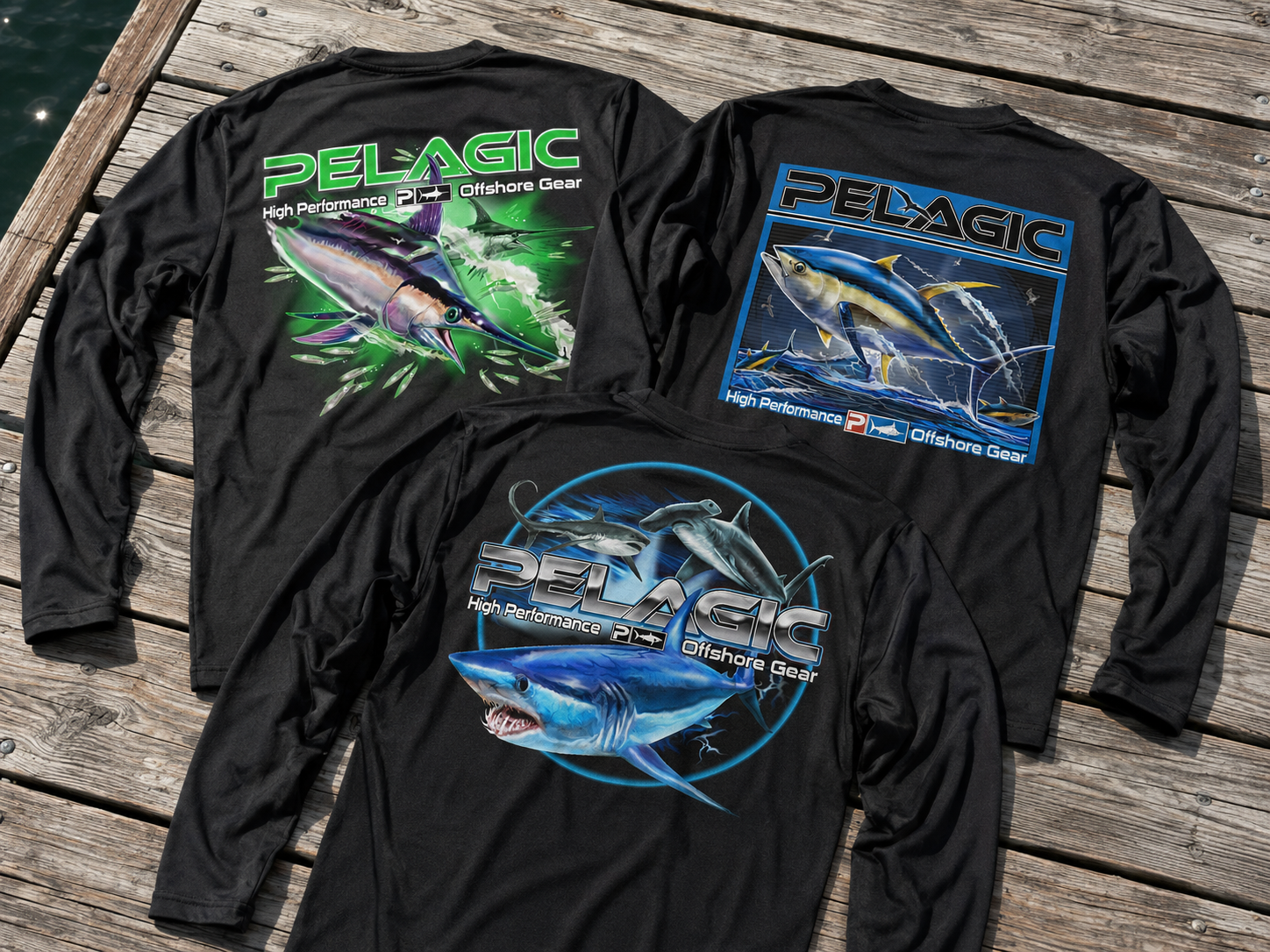
Yes. You can order custom boating shirts in small quantities, and in many cases you can order exactly one. The catch is that the cost structure works differently below a dozen pieces, and knowing how it works is the difference between paying a fair price and getting quoted a number that makes you abandon the idea entirely.
Here is the part most people miss. A custom shirt order has two separate costs that behave in opposite ways. The artwork is a fixed, one-time cost. The printing is a per-piece cost that changes dramatically depending on the method. Once you separate those two numbers in your head, small orders stop looking expensive and start looking obvious.
Can You Order Custom Boating Shirts in Small Quantities Without Overpaying?
You can order custom boating shirts in small quantities affordably as long as you choose a digital print method rather than screen printing. Screen printing charges a setup fee per color, so a run of four shirts carries the same setup as a run of forty. Digital methods have almost no setup, which is why they exist.
The typical minimums across the industry as of 2026 look like this:
- Direct-to-garment (DTG): no minimum, one shirt is fine
- Heat transfer and DTF: no minimum
- Screen printing: usually 12 to 24 pieces per design, some shops require 50 or more
- Embroidery: commonly 6 pieces
- Dye sublimation: commonly around 6 pieces
Vistaprint, for one example, advertises no minimum on DTG and heat transfer prints while requiring 6 pieces for screen printing. RushOrderTees applies no minimum to printed designs and a 6-piece minimum to embroidery. The pattern is consistent across the industry: the more physical setup a method requires, the higher its floor.
The Two Costs Behind Every Custom Shirt
Every custom shirt project splits into artwork and production. Confusing the two is the single most common reason people think small orders are impossible.
Artwork Is a Fixed, One-Time Cost
Original artwork costs the same whether you print 3 shirts or 300. That is a disadvantage at low volume and there is no way around it, but it is also a one-time payment that keeps working forever.
Published rates give a useful benchmark. BoldWater lists T-shirt design from $300 for pre-made artwork out of its Namedrop Catalog up to $2,000 for a fully custom detailed illustration with liberal licensing, with most custom shirt designs landing between $700 and $900. Its marine stock art single-use licenses start at $150, and its name drop designs that incorporate your own boat photo start at $300. Pricing is current as of the studio’s published quote page and can change, but the structure is what matters: there is a real ladder from budget to premium.
That ladder is how a private boat owner keeps a small project sensible. A family that wants six shirts for a summer of weekends does not need a two-thousand-dollar illustration. A name drop design with the boat name, home port and a licensed species illustration gets most of the emotional payoff at a fraction of the cost, and these can often be turned around in a day or two.
Production Is a Per-Piece Cost
Printing behaves the opposite way. It scales with quantity and drops as volume rises.
Current market figures put a single DTG-printed shirt at roughly $15 to $30, while the same shirt in a bulk run falls to about $8 to $12. Dark garments add roughly $3 to $6 per piece on DTG because they require a white underbase and pretreatment. The crossover point where screen printing becomes cheaper per unit generally sits somewhere between 12 and 24 pieces for a simple one to three color design.
For most families and private owners, that crossover never arrives, which is good news. Studios that handle marine and fishing apparel design as a specialty will often deliver print-ready files and point you to a printer suited to your quantity rather than forcing you into a minimum you do not need.
Print Method Comparison for Low-Volume Orders
Match the method to your quantity, not to what sounds most impressive. Here is how the options stack up for a private order.
| Method | Minimum | Best Quantity Range | Approx. Cost Per Shirt | Notes |
| DTG | 1 | 1 to 12 | $15 to $30 | Soft hand feel, unlimited colors, best on cotton |
| DTF transfer | 1 | 1 to 24 | $12 to $25 | Works on polyester and blends, durable |
| Screen printing | 12 to 24 | 24 and up | $8 to $15 | Cheapest at volume, setup fee per color |
| Embroidery | Around 6 | 6 to 50 | $18 to $35 | Premium look on polos, hats, quarter-zips |
| Dye sublimation | Around 6 | 6 and up | $25 to $45 | Full coverage on polyester, never cracks |
Two practical notes. Dye sublimation only works on polyester, which is also the fabric anglers want for UPF 50+ sun protection, so a family that wants performance shirts rather than cotton tees will usually land here or on DTF. And embroidery on a polo or quarter-zip is often the right answer for a boat owner who wants one nice piece rather than six casual ones.
How Many Shirts Does a Private Boat Owner Actually Need?
Most private orders land between 4 and 12 pieces. That range covers the people who are genuinely on the boat regularly plus a small buffer.
A realistic count looks like this:
- Owner and spouse: 2 to 4 pieces, often in two styles
- Children or regular crew: 2 to 6 pieces
- Frequent guests: 2 to 4 pieces
- Spares in common sizes: 2 pieces, because someone always asks
That total sits comfortably in DTG and DTF territory, which is exactly why small batch custom boating shirts have become far more accessible in the last several years. The technology caught up to the demand.
There is also a repeat-order angle worth planning for. Once the artwork exists, reordering is cheap, because you are only paying for garments and printing. Families frequently start with four shirts and add hoodies, hats and long sleeves over the following two seasons. Getting the file structure right at the start makes those later orders painless, and the apparel design quote request form is where that scoping conversation usually begins.
Five Ways to Keep a Small Order Affordable
Small orders get expensive through avoidable decisions, not through the quantity itself.
- Limit the color count. If you ever plan to move to screen printing, a two-color design costs far less to set up than a six-color one.
- Choose light garments. Dark shirts add $3 to $6 per piece on DTG because of the required white underbase.
- Start from a name drop or stock illustration. A licensed marine illustration paired with custom lettering costs a fraction of a fully original composition.
- Order all styles at once. Combining tees, long sleeves and hoodies into one production run avoids paying shipping and handling twice.
- Get one sample before the full run. DTG makes single-piece samples cheap, so you can check color and fit before committing.
That last point deserves emphasis. A sample costs the price of one shirt and eliminates the risk of six shirts arriving in a color that reads differently on fabric than it did on screen. A studio like BoldWater will also flag color and contrast problems at the proof stage, before anything reaches a press, which is cheaper than finding out after delivery.
What to Have Ready Before Requesting a Quote
Preparation shortens the timeline more than anything else. Designers cannot start until they know what they are drawing.
Bring these to the first conversation:
- Boat name, exact spelling and any stylization you want preserved
- A clear photo of the vessel, ideally from the angle you want illustrated
- Home port, coordinates or a meaningful date, if you want them included
- Target species or marine themes that matter to you
- Preferred shirt colors and garment types
- Existing transom lettering or boat graphics you want the shirt to match
- Your quantity and any hard deadline
You do not need a finished concept. A boat name, a photo and a rough idea of the feeling you want is a legitimate starting point, and a good studio will develop the direction from there. Reaching out through the contact page with those items attached typically produces a faster and more accurate quote than a general inquiry.
Realistic Timeline for a Small Order
Plan for four to six weeks from first conversation to shirts in hand. Small quantity does not mean fast.
The stages break down as follows:
- Design development: 1 to 3 weeks for custom artwork, or 1 to 2 days for a name drop design
- Review cycles: design fees commonly include a set number of revision rounds, often three
- Production after final approval: 2 to 3 weeks is a standard published window for print products
- Shipping: 3 to 10 business days
Rush options exist at most studios and printers but typically carry a fee and are not always available. If the shirts are meant for a specific weekend, a christening or a holiday, build in two extra weeks of buffer.
What You Actually Own When the Design Is Finished
Read the licensing terms before you assume the artwork is yours to use anywhere. This trips up more boat owners than any pricing question.
Design studios treat different asset types differently. BoldWater, for example, transfers full copyright of logo designs to the client once payment clears, while apparel designs carry a narrower license that does not automatically extend to using the same artwork as a logo, boat lettering or signage without written authorization. Files are typically delivered as high-resolution flattened images suitable for a printer, and clients are not required to print through the studio.
That distinction matters if you plan to reuse the design. A boat owner who wants one visual identity running across the transom, the shirts, the hats and the decals should say so upfront, because that is a different scope and often a different license than a standalone shirt graphic. Studios that cover boat graphics, lettering, logos and apparel under one roof can bundle those rights sensibly rather than leaving you to negotiate them piece by piece later.
Frequently Asked Questions
Is there a minimum order for custom boat shirts?
It depends entirely on the print method. Direct-to-garment printing, DTF transfers and heat transfers have no minimum, so you can order a single shirt. Screen printing typically requires 12 to 24 pieces per design because of setup costs, and embroidery and dye sublimation usually start around 6 pieces.
How much does it cost to make one custom boat shirt?
A single DTG-printed shirt typically costs $15 to $30 for the garment and printing, with dark colors adding roughly $3 to $6. Original artwork is separate and one-time. Published studio rates range from about $300 for a pre-made name drop design up to $2,000 for a fully custom illustration, with most custom shirt designs falling between $700 and $900.
Can I order just one custom shirt with my boat name on it?
Yes. Multiple providers advertise no minimum orders on printed boat apparel, and digital printing makes a one-piece order technically straightforward. The economics only make sense once the artwork exists, so single shirts are most common as samples before a larger run or as reorders after a design has already been paid for.
Is it cheaper to order custom shirts in bulk?
Yes, per shirt. Bulk pricing spreads setup costs across more units, dropping a DTG shirt from roughly $15 to $30 down to around $8 to $12 per piece. But total spend still rises with quantity, so ordering 30 shirts a family will never wear is not a saving. Order what you will use, plus a small buffer.
Do I need a design file to order custom boating shirts?
No. Most marine design studios start from a photo of your boat, the boat name and a description of what you want. If you already have vector artwork or existing transom graphics, sharing them speeds things up and helps keep the shirt consistent with the boat. If you have nothing but an idea, that is a normal starting point.
The Bottom Line
You can absolutely order custom boating shirts in small quantities, whether you need four for the family or a single shirt for yourself. Choose a digital print method, keep the color count tight, treat the artwork as a one-time investment rather than a per-shirt expense, and give the project four to six weeks.
Low minimum custom boat shirts are no longer a compromise. The printing technology closed that gap years ago. The only thing that still separates a good small order from a disappointing one is the quality of the artwork on the front of it.