Walk any working dock on a Saturday morning and you can tell which operations take themselves seriously within about four seconds. Custom boating shirts build brand recognition by turning your crew, your staff, and your customers into a moving, repeating display of your name in exactly the places your next booking is standing. A single branded shirt keeps working for years, in front of people who are already on the water, at a cost per view that no paid ad can match. For charter boats and marinas, that combination of longevity, credibility, and location makes apparel one of the highest-return marketing decisions available.
The catch is that not all branded shirts do this. A shirt with a stretched logo and an unreadable phone number generates the same number of views as a great one and converts almost none of them. The difference is in how the program is designed, not how much it costs.
Why Custom Boating Shirts Beat Almost Every Other Advertising Channel
Custom boating shirts build brand recognition through sheer repetition at a cost that traditional advertising cannot approach. The numbers behind branded apparel are unusually well documented, and they are the reason apparel remains a core marketing line item for businesses far larger than a six-boat charter fleet.
According to the 2026 ASI Global Advertising Impressions Study, which surveyed nearly 5,000 consumers across the US, Canada, Mexico, and Europe, a typical promotional product generates 3,300 brand views over its lifetime, and 85 percent of consumers remember the advertiser who gave them a logoed product.For T-shirts specifically, ASI calculates roughly 3,500 impressions per shirt at an average cost of about one third of a cent per impression, with four in five consumers keeping a branded shirt for at least a year and nine in ten wearing it at least monthly.
Outerwear performs even better because people keep it longer. ASI’s 2026 data puts fleece and jackets at roughly 9,000 lifetime impressions, ahead of bags at 4,900. That matters for northern marinas and shoulder-season charters, where a branded quarter-zip gets worn from the dock to the grocery store for years.
The channel comparison is what makes the case. ASI found that 75 percent of US consumers hold a positive opinion of branded merchandise, a higher share than television or digital advertising, and 76 percent are more likely to do business with a brand that gave them branded merch. Very little else in a charter marketing budget produces goodwill and impressions at the same time.
What Brand Recognition Actually Looks Like on the Water
Brand recognition for a marine business is not abstract awareness. It is a specific person, in a specific place, connecting your name to a good experience and then repeating that name to someone else. Apparel drives this in three distinct settings.
Recognition at the Dock
The dock is a closed community where the same faces circulate constantly. When your crew is visibly uniformed at the fuel dock, the ramp, and the ship store, other boaters begin recognizing your operation before they ever need it. That familiarity is what turns you into the default recommendation when a visitor asks the marina office who to call.
Legibility at distance is the whole game here. Most dock recognition happens from 40 to 80 feet away, across a slip or a parking lot, which means a logo that reads cleanly at that range is worth far more than a detailed one that turns to mush. Thoughtful custom apparel and T-shirt design treats viewing distance as a design constraint from the first sketch rather than an afterthought.
Recognition in Customer Photos
Every charter guest photographs their catch, and every one of those photos either carries your brand or does not. This is the most undervalued advertising channel a charter owns, because it costs nothing and reaches exactly the audience you want.
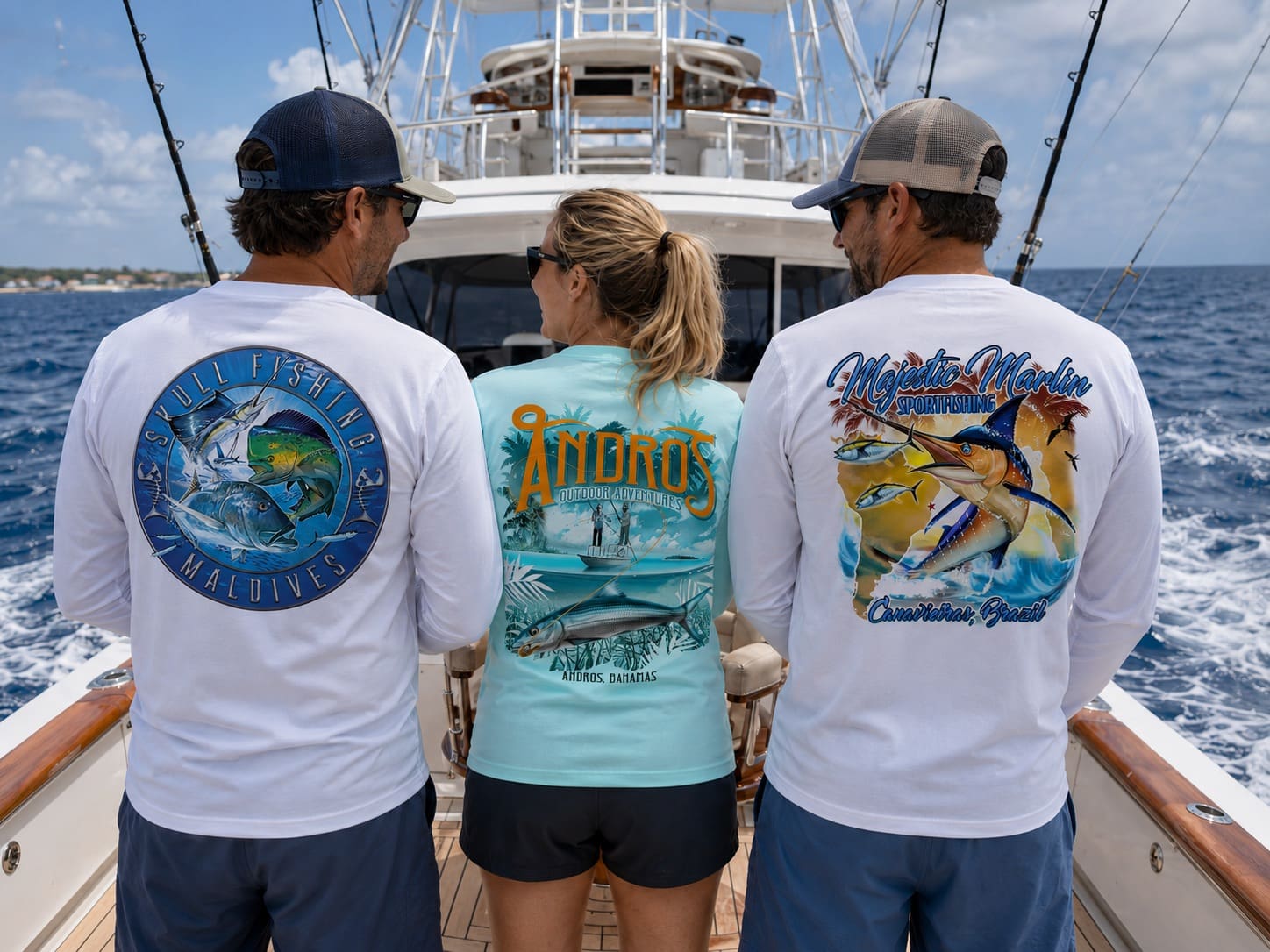
The mechanics are simple. A crew member holding a fish while wearing a clean back print puts your name in a photo that gets posted, texted to friends, and sometimes framed. Multiply that across a full season of trips and your shirt design becomes your most widely distributed marketing asset by an enormous margin.
Recognition in the Booking Decision
Recognition converts when someone comparing three charter listings picks the one that looks established. Branded apparel signals operational seriousness in a market where customers are handing over several hundred dollars to a stranger with a boat.
The research on uniforms supports this directly. A Harris Poll survey found that 70 percent of customers feel uniforms make employees look neater and more professional, and 97 percent say uniforms make employees easier to identify. On a boat where a guest needs to know instantly who to ask about the head, the bait, or the weather, easy identification is a service feature, not just a branding one.
Charter Boat Branding Shirts Turn Your Crew Into the Marketing
A charter crew in matched shirts is doing three jobs at once: working the boat, reassuring the customer, and advertising the business. The shirt is the only piece of your marketing that is present at the exact moment of the customer experience.
This works because charter customers judge professionalism from visual cues before they have any service to evaluate. A mate in a faded random tee and a captain in a branded polo reads as improvisation. A crew in a coordinated set reads as a business with standards, which makes the price feel justified and the tip feel earned.
The same shirt keeps selling after the trip ends. Guests wear charter shirts home, at airports, and around their own docks, where their friends ask where the shirt came from. That conversation is a referral you did not have to buy, generated by a garment you already produced. Studios that work across full marine design services can keep that shirt visually consistent with your boat lettering and transom graphics, so a guest who photographs the hull and a guest who photographs the crew are advertising the same recognizable mark.
Marina Branded Apparel Works on a Different Timeline
Marina apparel builds recognition through daily local repetition rather than trip-based bursts. A marina’s staff, slip holders, and retail customers see the brand constantly, and the apparel program should reflect that longer, steadier relationship.
The two use cases differ enough that they deserve different plans:
| Charter operation | Marina | |
| Primary wearer | Captain, mates, guests | Dockhands, office staff, slip holders |
| Recognition driver | Customer photos and takeaway souvenirs | Daily visibility and community identity |
| Best-selling item | Performance long sleeve with back artwork | Embroidered polos and hats, retail tees |
| Revenue role | Trip add-on sold at the dock | Ongoing ship store inventory |
| Design priority | Species and vessel artwork, high contrast | Clean logo, place name, understated finish |
| Reorder rhythm | Preseason and midseason restock | Continuous retail replenishment |
Marinas also have an asset most charters do not: a physical retail space with foot traffic. A well-designed marina shirt sells to slip holders, transient boaters, fishing club members, and locals who simply like the place name. That turns apparel from a marketing expense into a margin-positive product line while still generating impressions.
Event apparel deserves its own budget line for marinas. Tournaments, poker runs, yacht club regattas, and boat shows all create moments where a limited-run shirt sells out and puts your name on hundreds of people at once. Working with a marine design studio such as BoldWater on a flexible core mark lets each event carry its own look without rebuilding the brand from scratch. The event changes, the recognition compounds.
The Design Choices That Decide Whether Recognition Happens
Recognition depends on consistency far more than on cleverness. This is where most small marine businesses lose the value they paid for, usually without realizing it.
Research from Lucidpress and Marq, based on surveys of more than 600 brand management professionals, ties consistent brand presentation to revenue increases averaging 10 to 20 percent, with an upper bound of 33 percent. Consistency is not a design preference. It is the mechanism by which repeated views accumulate into recognition instead of confusion.
Three practical rules protect that consistency:
- Use one primary mark everywhere. The logo on the shirt should match the logo on the transom, the truck, the sign, and the website. Three variations mean three weaker brands.
- Record your specifications. Keep vector logo files, exact color codes, and approved placement measurements on hand so every reorder and every vendor produces the same result.
- Design for the hardest application first. A mark that survives being embroidered small on a polo will also work large on a back print. The reverse is rarely true.
Most brand drift comes from missing documentation rather than bad taste. When nobody can find the original artwork file, the next order gets rebuilt from a screenshot, and the mark quietly degrades a little each time. BoldWater builds and archives production-ready artwork specifically so charter and marina clients can reorder years later and get an identical result.
How to Build an Apparel Program Instead of Buying Shirts
Treat apparel as a small system with a plan rather than a one-time purchase. Operations that do this get compounding recognition. Operations that do not end up with four mismatched shirt designs and no clear identity.
A workable program looks like this:
- A single core design that adapts across shirts, hats, polos, and outerwear
- A working tier in technical fabric for crew and staff who wear it daily
- A retail tier in softer, lower-cost garments for guests and slip holders
- An event tier for tournaments and seasonal runs, using the same brand elements
- A documented file set so reorders never require redesign
Start with the artwork, because every downstream decision depends on it. An apparel design quote request that describes your boat or marina, your target species or location, your existing brand assets, and how the shirts will be used gives a designer enough to build something that works across all four tiers at once.
How to Tell Whether It Is Working
Track a few simple signals rather than trying to calculate a precise return. Apparel recognition builds gradually, so month-to-month noise is not meaningful, but season-over-season direction is.
Watch for these:
- Guests asking to buy a shirt at the end of the trip, and how often
- Photos tagging your business where the shirt is visible
- New customers saying they saw your name somewhere before calling
- Repeat and referral bookings as a share of the total
- Shirt sales as a standalone revenue line
If guests are asking for shirts unprompted, your design is doing its job. If nobody asks, the artwork is the problem rather than the concept. That is usually fixable, and it is worth a conversation with a designer before ordering another round of the same thing. You can reach the BoldWater team to review what you are running now against what your dock and your photos actually need.
Frequently Asked Questions
How does branded apparel help build brand recognition for a charter or marina?
They generate repeated, low-cost brand views in front of a boating audience over a long period. ASI’s 2026 research estimates roughly 3,500 lifetime impressions per branded T-shirt at about one third of a cent per impression, and shirts stay in circulation for years. For charter boats and marinas, those views happen at docks, ramps, tournaments, and in customer photos, which is exactly where new business originates.
Do branded crew shirts actually bring in more bookings?
Branded shirts influence bookings indirectly by increasing recognition and perceived professionalism rather than acting as a direct response ad. ASI found that 76 percent of consumers are more likely to do business with a brand that provided them with branded merchandise, and a Harris Poll survey found 70 percent of customers view uniformed staff as more professional. In a market where customers choose between similar-looking listings, that perception gap decides the booking.
Should a marina sell branded apparel or give it away?
Most marinas should do both, using different garments for each. Give branded polos and hats to staff so the brand is visible daily, and stock retail tees, hoodies, and hats in the ship store as a margin-positive product line. Slip holders and transient boaters buy place-name apparel readily, which means the retail side can fund the staff side.
What should go on a charter boat crew shirt?
Keep it to your business name, your primary artwork, and one contact path, usually a website. A left chest mark handles identification while the back panel carries the illustration that shows up in photos. Adding a phone number, a slogan, three sponsors, and a social handle shrinks everything until none of it is readable at dock distance.
Is embroidery or printing better for building recognition?
Embroidery is better for the polos and hats your staff wears daily because it lasts the life of the garment and reads as premium. Printing is better for large back designs and retail tees because it reproduces detailed artwork at a lower cost per piece. Most charter and marina programs use both, built from a single design so the brand stays consistent across every item.
The Bottom Line: Custom Boating Shirts Build Brand Recognition
Custom boating shirts build brand recognition for charter boats and marinas because they put a consistent, credible version of your name in front of the boating community every day, for years, at a cost per impression that no other channel can match. The value comes from consistency rather than volume, so one strong design used everywhere will outperform four weak designs used once each. Document your artwork, split your program into working, retail, and event tiers, and treat every shirt as a piece of your identity rather than a giveaway. Do that, and the shirts keep selling your charter or marina long after the season ends.