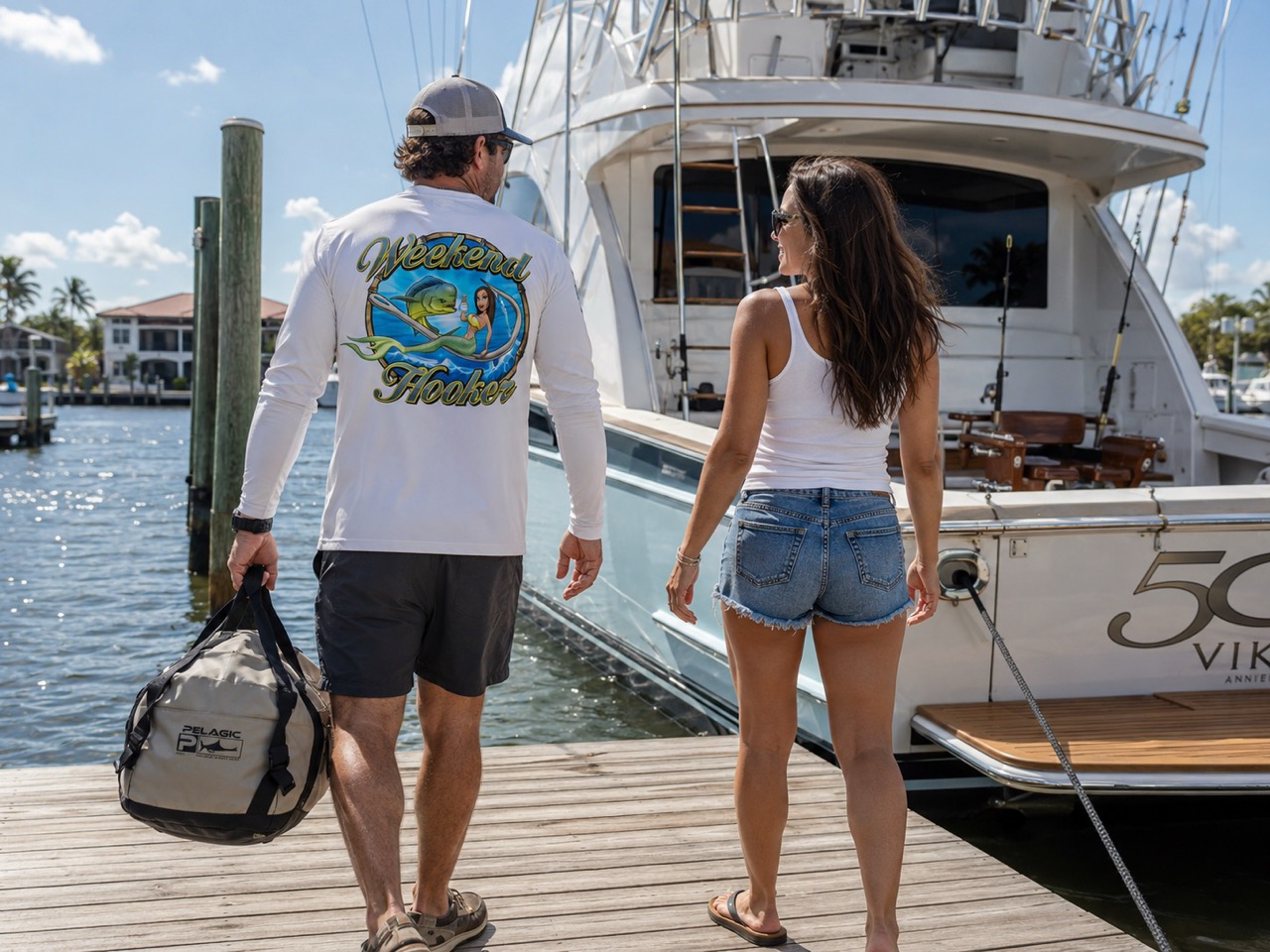
Charter boat owners can order fully custom boating shirts from four types of provider: print-on-demand platforms, local screen printers, team apparel suppliers, and dedicated marine design studios. Only the last category produces original artwork built around your vessel, your target species and your brand. The other three print what you hand them.
That distinction is the whole decision. A charter operation is not buying shirts, it is buying a piece of its brand that walks around a marina parking lot for the next five years. Get the artwork wrong and you have a stack of inventory nobody buys. Get it right and every guest who wears it home becomes a billboard in a market you will never advertise in.
Who Actually Makes Fully Custom Boating Shirts?
Fully custom boating shirts require two separate capabilities: original illustration and apparel production. Very few providers do both well, and most operations end up combining a design source with a print source. Knowing which category you are dealing with prevents the most common frustration in this process.
Here is how the four provider types compare:
| Provider Type | Original Artwork | Typical Minimum | Marine Subject Knowledge | Best For |
| Print-on-demand platforms | No, you supply files | 1 piece | None | Testing a design you already own |
| Local screen printers | Limited, often clip art | 12 to 24 pieces | Varies widely | Production when art is finished |
| Team apparel suppliers | Template-based | 6 to 12 pieces | Low | Sublimated crew jerseys at volume |
| Marine design studios | Yes, fully original | Design is separate from print | High | Charter brands building an identity |
The market for this is bigger than most captains realize. IBISWorld counted 5,773 fishing boat charter businesses operating in the United States as of January 2026, up 4.6% from the prior year, with the business count growing an average of 7.9% annually between 2021 and 2026. That is a lot of operations competing for the same guests, and apparel is one of the few marketing assets that keeps working after the trip ends.
What Separates a Marine Design Studio From a T-Shirt Printer
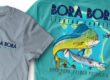
A marine design studio sells artwork. A printer sells production. Confusing the two is why so many charter shirts end up looking like a stock marlin dropped onto a blank.
The gap shows up in details anglers notice immediately. A sailfish bill has a specific proportion. A bull mahi has a different forehead profile than a cow. A center console does not look like a sportfisher, and a Gulf Coast bay boat does not look like a New England groundfish boat. Guests may not consciously register these things, but other captains will, and so will the serious anglers you want as repeat clients.
Professional marine apparel design also solves problems that have nothing to do with drawing. Print area, garment color, ink limits, viewing distance and typography all constrain what the artwork can be. Studios that handle custom marine and fishing apparel artwork plan for those constraints from the first sketch rather than discovering them at the proof stage.
What a Charter Operation Actually Needs From a Shirt Program
A charter shirt has to serve at least three jobs at once, which is more than a private boat shirt has to do.
- Crew uniform. Consistent, professional, comfortable across a full day, easy to identify at the dock.
- Guest souvenir and merchandise. Attractive enough that someone pays for it, not just accepts it free.
- Marketing asset. Legible from a distance, carrying the business name and often the phone number or website.
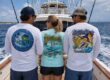
Smart operators differentiate the crew version from the retail version. A common approach is one garment color for crew and a different color for resale, so guests can identify staff instantly while still buying the same design. Adding crew names on the left chest reinforces the difference at almost no extra cost.
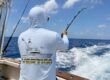
Coverage and comfort matter more for crew than for guests. Captains and mates are on deck sunrise to afternoon, so UPF 50+ long sleeves with vented panels are worth the upgrade even when the retail version is a cotton tee. Studios that also handle boat graphics, lettering, logos and web design can keep the transom, the hats, the shirts and the booking site reading as one business rather than four disconnected efforts.
How to Evaluate a Provider Before You Commit
Ask the same six questions of anyone quoting your project. The answers separate real studios from order-takers fast.
1. Can I See a Deep Portfolio in My Category?
Look for volume and range, not three polished samples. A studio that has done hundreds of charter, tournament and boat owner projects has solved problems yours will hit. Ask specifically for charter and guide work rather than general apparel.
2. Do You Understand the Species and the Fishery?
This is the fastest credibility test in marine design. A studio with real fishing background will ask what you target, where you fish and what your season looks like before discussing visuals.
3. What Files Do I Receive?
Deliverables vary more than people expect. Highly detailed illustration is usually delivered as flattened high-resolution raster files such as 300 dpi TIFF or JPG, while simpler logos and line art come as vector. Ask whether color separations are included, because many design studios do not produce them and the printer handles that step.
4. How Many Revision Rounds Are Included?
A quoted design fee normally covers a set number of review cycles, commonly three. Beyond that, additional time is often billed hourly. Knowing the number upfront prevents an uncomfortable conversation in week three.
5. Am I Required to Print With You?
Many design studios deliver artwork and let you choose a printer, which is an advantage when your quantity is small or you already have a local relationship. BoldWater, for example, does not include apparel production in its design fee and will either refer a trusted printing partner or send the artwork files to a printer of your choice.
6. What Does the License Actually Cover?
This is the question charter owners skip and later regret. Apparel design licenses are frequently narrower than logo licenses, and using shirt artwork as a company logo, boat lettering or signage may require separate written authorization. If you intend to resell shirts as retail merchandise, say so during the quote, because retail licensing is a different scope than a one-time crew run.
What Fully Custom Marine Artwork Costs
Design and production are separate line items, and mixing them up is why quotes seem to vary wildly.
Published rates give a workable benchmark. BoldWater lists T-shirt design starting at $300 for pre-made artwork from its name drop catalog and running up to $2,000 for fully custom detailed illustration with liberal licensing, with most custom shirt designs landing between $700 and $900. Marine stock art single-use licenses start at $150. Those figures are from the studio’s published quote page and are subject to change, but the tiering is what matters.
That ladder gives a charter operation real options:
- Name drop tier, around $300. Pre-built artwork with your business name, location and species dropped in. Often turned around in one to two days.
- Stock art license, from $150. License an existing gamefish illustration and build a simpler layout around it.
- Mid-range custom, roughly $700 to $900. Original composition built specifically for your boat and fishery. This is where most charter projects land.
- Premium custom, up to $2,000. Detailed illustration with broader licensing, appropriate when the artwork will anchor retail merchandise and a full brand identity.
Production sits on top of that and scales with quantity. Screen printing gets cheaper per shirt above roughly 24 pieces, while direct-to-garment and DTF handle small runs without setup fees. A first-season charter testing demand is usually better off with a modest design fee and a small print run, then reinvesting once the shirts sell. Scoping both halves together through an apparel design quote request produces a more accurate number than pricing them separately.
What to Prepare Before You Request a Quote
Preparation is the single biggest factor in how fast a project moves. Designers cannot start until they know what they are drawing.
Have this ready:
- Business name exactly as it should appear, plus phone number or website if you want them on the shirt
- Home port, marina and the waters you fish
- Target species, ranked by what your guests actually want to catch
- Clear photos of your vessel from the angle you want illustrated
- Any existing logo, transom lettering or boat wrap graphics
- Garment preferences: performance versus cotton, long versus short sleeve, colors
- Whether the shirts are for crew only, resale, or both
- Quantity estimate and any hard deadline
You do not need a finished concept. A business name, a target species and a boat photo is a legitimate starting point, and an experienced studio will develop the direction from there. Sending those details through the contact page rather than a one-line inquiry typically cuts a week off the front end.
Realistic Timeline for a Charter Shirt Program
Plan six to eight weeks from first conversation to shirts on the rack. Season deadlines do not move, and rush options carry fees.
The stages break down like this:
- Design development: 1 to 3 weeks for original artwork, or 1 to 2 days for a name drop design
- Review cycles: several days per round, with three rounds commonly included
- Production after final approval: 2 to 3 weeks is a standard published window for print products
- Shipping and stocking: 1 week
For a spring season opener, that means starting in late winter. Charter operators who wait until the first warm week are competing with every other business in the region for the same print slots.
Where a Studio Fits Into a Wider Brand
The strongest charter brands do not commission a shirt. They commission an identity and then apply it.
One illustration, planned correctly, becomes a back print, a left-chest mark, an embroidered hat, a transom graphic, a decal, a social profile image and a website header. Planning those adaptations together costs meaningfully less than commissioning them one at a time over three seasons, and it produces a business that looks established rather than assembled.
That is the argument for working with a studio that lives in the marine market rather than a general apparel vendor. BoldWater has been producing marine and fishing artwork for more than 25 years, with client work spanning Pelagic, Boston Whaler, Sea Ray, Berkley and Spanish Fly alongside independent charter captains and guides. Depth in the category is what lets a designer get the species right and the culture right at the same time.
Frequently Asked Questions
Where can I get custom fishing charter shirts made?
You have four realistic options: print-on-demand platforms if you already own artwork, local screen printers for production, team apparel suppliers for sublimated crew jerseys at volume, and marine design studios for original artwork. Most charter operations use a design studio for the artwork and a printer for production, since the two are separate services.
How much does professional marine apparel design cost?
Published studio rates range from about $300 for pre-made name drop artwork up to $2,000 for fully custom detailed illustration with broader licensing, with most custom shirt designs falling between $700 and $900. Stock marine illustration licenses can start around $150. Apparel production is billed separately and scales with quantity.
Do I have to print through the same company that designs my shirts?
Usually not. Many marine design studios deliver print-ready artwork files and either recommend a printing partner or send the files to a printer you choose. Ask this during the quote, and confirm whether color separations are included, since many design studios do not produce them.
Can I sell charter shirts as merchandise to my guests?
Yes, but confirm the licensing terms first. Apparel design licenses are often narrower than logo licenses, and retail resale can require a broader license than a one-time crew run. Tell the studio during the quote stage that the shirts will be sold, so the scope and license match the intended use.
How long does it take to get custom charter boat shirts?
Budget six to eight weeks end to end. Original artwork takes one to three weeks plus review rounds, production runs about two to three weeks after final approval, and shipping adds another week. Name drop designs can be produced in one to two days, which shortens the front end considerably.
The Bottom Line
Charter boat owners looking to order fully custom boating shirts should separate the two purchases in their head: artwork from a studio that knows marine subject matter, production from a printer matched to their quantity. Ask about portfolio depth, file deliverables, revision rounds and licensing before signing anything, and be explicit if you plan to resell.
Then start earlier than feels necessary. A shirt that guests actually want to buy takes a few weeks of design and a few weeks of production, and it earns its cost back every time somebody wears it home to a state you have never marketed in.