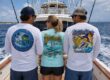
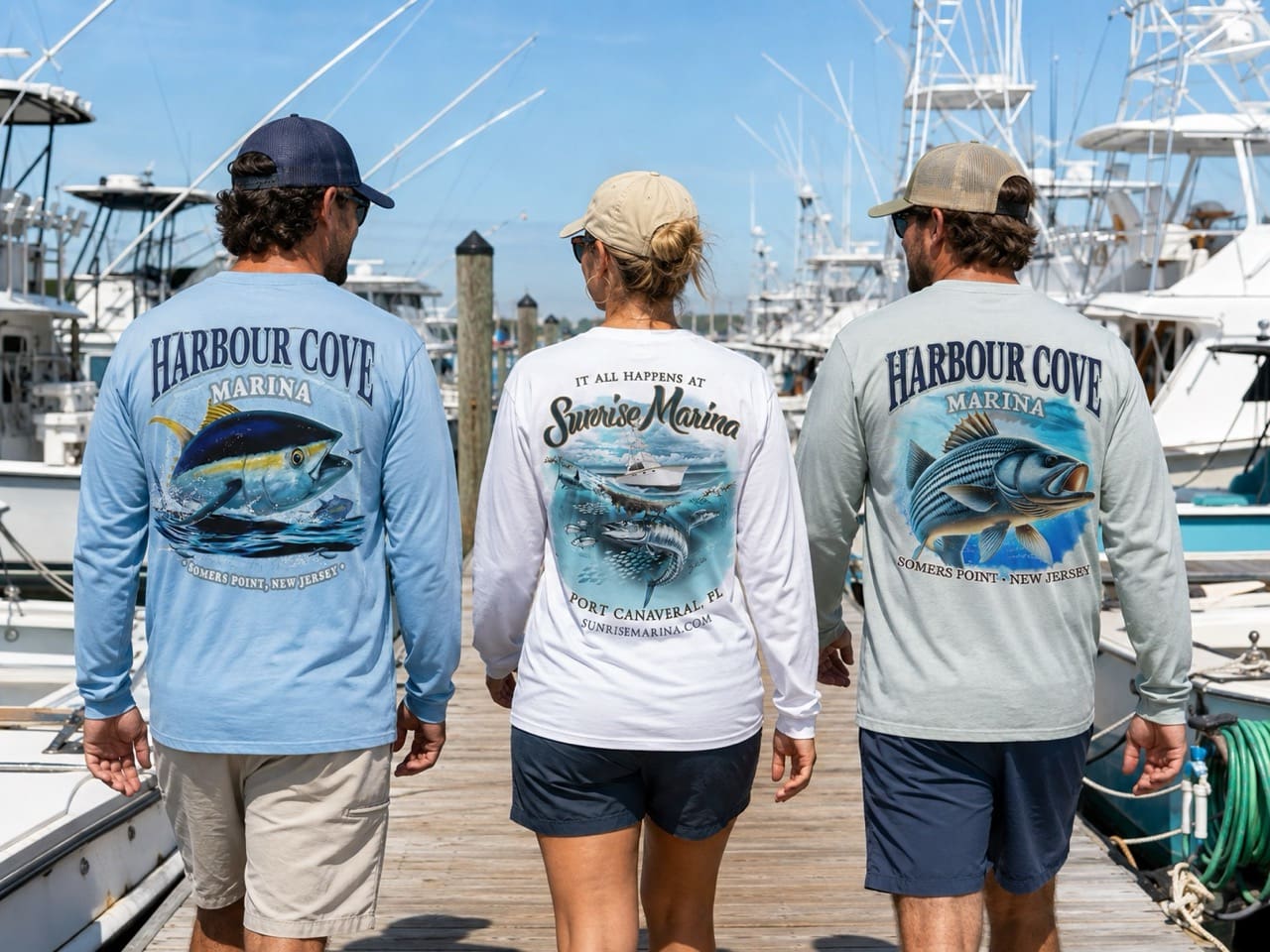
Six hours into an offshore run, the difference between a good crew shirt and a cheap one is obvious to everyone standing in the cockpit. The best custom boating shirts for fishing charter crews are long sleeve UPF 50+ performance shirts in light colors, built from lightweight polyester or a polyester blend, decorated with artwork designed specifically for the print area, and ordered as a coordinated set that covers the captain, the mates, and paying guests. You order them by locking the artwork first, choosing garment styles and sizes second, and matching the decoration method to your quantity third. Get that sequence right and one order carries your charter through multiple seasons while advertising the boat at every dock, weigh station, and airport terminal your customers walk through.
This guide covers what to look for in the shirt itself, which styles suit which role on the boat, how printing methods change cost and lifespan, and the exact ordering process from first sketch to delivered box. Everything below is written for working charter operations that need gear to survive salt, sun, fish blood, and eighty wash cycles a season.
Why Charter Crew Shirts Are Working Uniforms, Not Souvenirs
A charter crew shirt does two jobs at the same time, and most operators only plan for one of them. It is protective equipment for people who work outdoors for a living, and it is the most-seen piece of marketing your business owns.
Consider what a single shirt is asked to do over one trip:
- Block ultraviolet radiation for six to twelve hours of continuous exposure
- Move sweat off the skin and dry fast after a wave over the bow
- Survive contact with fish slime, sunscreen, blood, and deck cleaner
- Look presentable when a customer photographs the crew holding a fish
- Read clearly at fifty feet so the boat name is legible in that photograph
That last point is where money is made or lost. Charter customers post their catch photos publicly, and every one of those images either carries your brand or wastes the opportunity. A shirt with a muddy, overcrowded back print becomes invisible at distance. A shirt with a clean, high-contrast design becomes a billboard that travels home with the customer.
What Makes the Best Custom Boating Shirts for Fishing Charter Crews
The best custom boating shirts for fishing charter crews combine four measurable attributes: a synthetic fabric with a verified sun protection rating, a cut that allows full casting and gaffing motion, a color that hides wear, and artwork engineered for the print method being used. Miss any one of the four and the shirt underperforms in a way your crew will complain about by week three.
Fabric: Polyester Outperforms Cotton on the Water
Polyester and polyester blends beat cotton on every metric that matters offshore. Cotton absorbs water and holds it against the skin, which makes it heavier, slower to dry, and less protective when wet. Synthetic performance fabric wicks moisture toward the surface where it evaporates, keeping the garment light through a full charter day.
The sun protection gap is even wider. A standard cotton shirt provides roughly UPF 5 to UPF 10 of protection, meaning six hours in that shirt exposes your skin to the equivalent of 36 to 48 minutes of unprotected sun. A purpose-built performance shirt rated UPF 50+ blocks 98 percent of ultraviolet radiation, and the best versions achieve that rating through fiber type, weave density, and color rather than a chemical coating that washes out.
Ask any supplier one specific question before you commit: is the protection structural or applied? Structural protection is engineered into the fabric and holds through repeated laundering. Applied chemical treatment degrades. Look for fabric rated to hold its protection through at least 50 wash cycles.
Sun Protection Ratings You Can Actually Verify
UPF measures how much ultraviolet radiation a fabric blocks, and the rating covers both UVA and UVB wavelengths. UPF 50+ is the top tier available in commercial apparel. For a charter crew, that is the number to insist on rather than settle for.
The exposure math justifies the spend. Charter fishing trips put anglers and crew in six to twelve hours of direct sun on open water with almost no shade, and ultraviolet reflection off the water surface increases total radiation by 25 to 30 percent. Your crew absorbs that load five or six days a week for an entire season.
This is also why long sleeves are the professional default rather than a preference. Long sleeves cover roughly 40 percent more skin than short sleeves, and covered skin needs no reapplication of anything. A crew in long sleeve performance shirts stops interrupting the trip to reapply sunscreen with fish-slimed hands.
Fit, Coverage, and Freedom of Movement
Charter work is physical, so the cut matters as much as the fabric. Crew members reach overhead for rods, lean over gunwales, gaff fish, wash decks, and lift coolers. A shirt that binds across the shoulders gets rolled up or taken off, which defeats the point of buying it.
Look for these construction details when you evaluate samples:
- Flatlock seams that lie flat and reduce chafing during long wear
- Some stretch content in the fabric so the shoulders move with the body
- Vented back panels or mesh underarms for airflow in humid conditions
- A relaxed body cut that does not cling when wet
- Thumb loops or extended cuffs if your crew wants hand coverage
Hooded styles deserve serious consideration for offshore work. A hood with a built-in neck gaiter covers the ears, neck, and lower face in one piece, which removes the need for separate buffs and hats that blow overboard.
Color Choices That Survive a Full Season
Light and mid-tone colors are the practical choice for charter crews. Light colors read cooler in direct sun, and mid-tones like heather grey, seafoam, and steel blue hide salt stains and general grime better than either white or black.
White looks sharp on day one and looks tired by mid-season. Solid black absorbs heat and shows salt residue as a chalky film. If you want the crew to look uniform in customer photos across the whole summer, pick a color that ages gracefully rather than one that photographs perfectly for the first two weeks. BoldWater builds shirt color into the artwork decision from the beginning, because ink colors that pop on navy can disappear entirely on light grey.
Charter Boat Crew Shirt Styles, Ranked by Role on the Boat
Different people on the boat need different garments, and the strongest orders mix styles rather than buying one shirt for everyone. A coordinated family of pieces looks more professional than a single style stretched across every role.
Here is how experienced operations typically split it:
- Long sleeve hooded performance shirt for mates and deckhands who work exposed positions all day
- Long sleeve crew neck performance shirt as the everyday standard for the full crew
- Performance polo for the captain, the dock manager, or anyone greeting customers and handling money
- Short sleeve performance tee for inshore half-day trips and hot dock work
- Quarter-zip or light hoodie for early departures, winter runs, and northern climates
- Short sleeve cotton-blend tee as the retail item you sell to guests rather than wear to work
That last distinction saves real money. Working shirts and resale shirts have different requirements. Crew shirts need technical fabric and maximum durability. Guest shirts need to feel soft, look great in a photo, and hit a price point people will pay at the dock. Ordering both from one design keeps the brand consistent while letting you spend appropriately on each.
Do not forget women’s cuts and youth sizes. Charter crews are increasingly mixed, and families booking full-day trips regularly buy shirts for kids as a keepsake. An order that only covers men’s medium through 2XL leaves revenue on the table.
Which Printing Method Is Best for Charter Crew Shirts?
Match the decoration method to your quantity, your fabric, and the number of colors in your artwork. This single decision affects price, feel, and lifespan more than any other choice in the order.
| Method | Best for | Typical quantity | Durability | Watch out for |
| Screen printing | Bold 1 to 6 color designs on cotton and blends | 50 pieces and up | Holds 40 to 60 washes before visible fading | Setup charge per color; dye migration on dark polyester |
| Digital print (DTG or DTF) | Full-color, photographic, or gradient artwork | 1 to 50 pieces | Good, softer hand feel | Less opaque on dark garments than screen ink |
| Embroidery | Left chest logos, polos, caps, captain shirts | Any quantity | Lasts the life of the garment | Fine detail and small text do not stitch cleanly |
| Dye sublimation | Edge-to-edge prints on light polyester performance wear | Small runs and up | Cannot crack, peel, or fade | Requires high polyester content and light fabric |
A few numbers worth knowing before you request quotes. Screen printing runs roughly $2 to $5 per shirt at 100 or more units with a setup charge of $25 to $75 per color, while embroidery typically adds $3 to $8 per piece and charges by stitch count rather than color count. Screen printing is the cheapest and most durable option for orders of 50 pieces or more with simple artwork, while digital printing wins for smaller runs of complex, full-color designs.
Two technical constraints trip up charter operators regularly. Dye sublimation only works on fabric that is at least 65 percent polyester, and designs print faded and uneven below that threshold. Embroidered text needs about 5mm of height in a bold block font to stay legible, and thin or script fonts require 8mm or more. That means a detailed illustration of a sailfish and a phone number cannot both live in an embroidered left chest logo.
The practical answer for most charter operations is a combination. Embroider the captain polos with a clean mark. Screen print or digitally print the crew shirts with the full back artwork. Design once, then adapt that artwork for each application, which is exactly what custom apparel and T-shirt design work is meant to solve before anything reaches a press.
Design Details That Make Charter Crew Shirts Look Professional
Artwork quality is the single biggest visual difference between a charter that looks established and one that looks like it started last month. The garment is a commodity. The design is not.
Front and Back Placement
Use the front for identification and the back for impact. A left chest mark or a small centered lockup on the front stays visible when a crew member wears a life vest, leans on a rail, or stands behind a cooler. The back panel is where a full illustration earns its keep, because that is what shows in photos taken from behind the crew during a fight.
Keep the back design tall and centered rather than wide and low. Artwork that sits too low disappears below the frame in most photos and gets tucked into shorts.
Species and Vessel Accuracy
Fishing customers notice details, and getting them wrong undermines credibility fast. The species you target should be drawn correctly, with the right fin shape, coloration, and body proportion. A generic marlin silhouette on a shirt for a redfish guide reads as careless to anyone who fishes.
The same applies to the boat. If your artwork includes the vessel, the hull style and profile should match what customers actually board. Charter operators who run a center console should not be wearing a shirt illustrated with a convertible sportfisher. Studios that work across marine design services including boat lettering and transom graphics can keep the shirt, the hull, and the logo visually consistent, which is what makes a small operation look like an established brand.
Contact Information, Used Sparingly
Include your business name and one contact path, usually a website or a phone number. Resist the urge to add a social handle, a slogan, a sponsor, and a hashtag. Every element you add reduces the size and legibility of everything else.
A useful test: print the design at business card size. If the boat name is still readable, the hierarchy is right. If it turns to mush, the layout has too much in it.
How Do You Order Custom Boating Shirts for a Fishing Charter Crew?
Order in this sequence: define the use case, gather brand assets, develop the artwork, select garments, confirm quantities and sizes, approve a proof, produce, then archive the files for reorders. Working in that order prevents the most expensive mistake in custom apparel, which is designing artwork that the chosen print method cannot reproduce.
The Step-by-Step Process
- Define how the shirts will be used. Crew uniforms, guest gifts, retail resale, or all three. This determines fabric and budget per unit.
- Collect your existing brand assets. Logo files in vector format, brand colors, boat name spelling, home port, and any sponsor marks that must appear.
- Choose your target species and visual direction. Bold and aggressive, clean and modern, or detailed and illustrative. Reference images of styles you like are more useful than descriptions.
- Have the artwork developed for the print area. This is where a designer accounts for shirt color, ink count, print size, and how the design will scale down for hats and left chest applications.
- Select garments and decoration method together. Fabric content determines what can be printed on it, so pick both at the same time rather than in sequence.
- Build your size run and quantities. Count crew, then add resale inventory and spares.
- Approve a digital proof, and a physical sample if the order is large. Check colors, placement, and print dimensions against a garment you can hold.
- Archive production files after delivery. Print-ready separations, vector artwork, and thread color references make your next reorder fast and identical to the first.
Charter operators who want the artwork handled properly before quoting print typically send BoldWater an apparel design quote request that outlines the boat, the species, the intended use, and any existing branding. The more of that information you supply up front, the fewer revision rounds the project needs.
How Many Shirts to Order and in What Sizes
Order enough that each working crew member has three to four shirts in rotation. A crew of four therefore needs twelve to sixteen working shirts as a baseline, before any resale inventory.
A practical size distribution for a mixed crew and guest order looks like this:
- Working crew: actual measured sizes, ordered generously since performance fabric fits close
- Resale inventory: weighted toward medium, large, and XL, which move fastest
- Guest and family sales: include women’s cuts and at least two youth sizes
- Spares: two to three extras in your most common size for new hires and lost shirts
Quantity also changes your unit economics. Because screen printing setup costs are fixed per color, the per-shirt price drops steeply as volume rises. Ordering 100 shirts once is meaningfully cheaper per unit than ordering 25 shirts four times.
What Do Charter Crew Shirts Actually Cost?
Budget for three separate line items rather than one price per shirt: the garment, the decoration, and the artwork. Quotes that bundle everything into a single number make it impossible to see where you can save.
- Blank performance garment: the largest variable, rising with fabric quality and sun protection rating
- Decoration: roughly $2 to $5 per shirt for screen printing at volume, or $3 to $8 per piece for embroidery
- Setup: $25 to $75 per screen color, charged once and reusable on reorders
- Artwork: a one-time investment that carries across shirts, hats, decals, boat graphics, and signage
That final point is the one most operators undervalue. Good artwork is not a shirt expense. It is a brand asset you will reuse for a decade across every surface your business touches. If you want to discuss how one design carries across apparel and vessel graphics, you can reach the design team directly and talk through the whole package rather than solving apparel in isolation.
Care, Washing, and Replacement Timeline
Wash performance shirts in cold water, skip the fabric softener, and hang or tumble dry on low. Fabric softener coats synthetic fibers and reduces their ability to wick moisture, which is the whole reason you bought them.
Rinse salt out the same day when you can. Dried salt crystals are abrasive and grind at fibers and print edges over time. A quick freshwater soak before the shirt goes in the hamper measurably extends its life.
Plan on replacing heavily used crew shirts every one to two seasons. Screen printed graphics generally start fading after 40 to 60 washes, and a shirt worn five days a week will pass that mark inside a single busy season. Rotating four shirts instead of two roughly doubles how long the set lasts.
Mistakes That Cost Charter Operators Money
Most apparel regret traces back to the same handful of decisions. Each one is avoidable at the planning stage and expensive to fix after production.
- Designing before choosing a print method. Full-color gradient artwork cannot be screen printed in two colors without being redrawn.
- Ordering the minimum. Setup costs get spread across too few units, so the per-shirt price stays high and you reorder sooner anyway.
- Cramming everything onto the back. Boat name, species, home port, phone, website, and three sponsors compete until nothing is legible.
- Choosing cotton for working crew shirts. It holds water, dries slowly, and provides a fraction of the sun protection.
- Losing the production files. Rebuilding artwork for a reorder costs money and rarely matches the original exactly.
- Skipping the physical sample on large orders. Screen colors and fabric colors both shift from what you see on a monitor.
Frequently Asked Questions
What kind of shirts do fishing charter crews wear?
Most professional fishing charter crews wear long sleeve UPF 50+ performance shirts made of polyester or polyester blends, often in hooded styles for offshore work. Captains and customer-facing staff frequently wear performance polos instead, usually with an embroidered logo. Cotton tees are generally reserved for resale to guests rather than daily crew use, because cotton offers far less sun protection and dries slowly.
Are long sleeve or short sleeve shirts better for charter fishing?
Long sleeve is better for charter crews and full-day trips, because it covers roughly 40 percent more skin and eliminates constant sunscreen reapplication. A tightly woven long sleeve performance shirt often feels cooler in direct sun than exposed skin, since the fabric reflects radiation at the surface and wicks sweat away. Short sleeve styles work well for short inshore trips, dock work, and resale items.
Is embroidery or screen printing better for charter boat crew shirts?
Embroidery is better for small left chest logos, polos, and caps, and it lasts the life of the garment. Screen printing is better for large multi-color back designs on tees and it costs significantly less per piece at volume. Many charter operations use both: embroidered polos for the captain and printed performance shirts for the crew, all built from the same artwork.
How many custom shirts should a charter business order at once?
Order at least three to four working shirts per crew member, plus resale inventory if you sell to guests. Larger single orders lower the per-shirt cost because setup charges are fixed and spread across the run. Most charter operations find that a single order of 75 to 150 pieces across styles and sizes delivers better pricing than several small orders through the season.
Can charter operators sell crew shirts to their customers?
Yes, and shirt sales are a common secondary revenue stream for charter businesses. Guests regularly buy a shirt as a souvenir at the end of a good trip, especially designs featuring the target species and the boat name. Stock a lighter, softer garment for retail, keep the design consistent with your crew shirts, and include women’s and youth sizes to capture family bookings.
The Bottom Line
The best custom boating shirts for fishing charter crews are long sleeve UPF 50+ performance shirts in a durable synthetic fabric, decorated with artwork that was designed for the print method and the garment color from the start, and ordered in enough volume to make the per-unit economics work. Order them by settling the artwork first, then the garments, then the decoration method, and archive the production files so every reorder matches. Handle it in that order and your crew stays protected, your photos advertise the boat, and one design keeps working for years across shirts, hats, decals, and the transom itself.
If you are ready to put a real design behind your charter, the BoldWater studio has been creating custom fishing and boating apparel artwork for more than 25 years for charter captains, guides, tournament teams, and marine brands.